• Michael Rosen’s Getting Through It is a two-part show formed of two stories: The Death of Eddie and Many Kinds of Love. In the first of these, he takes us through the day his son Eddie died in 1999, the moments that followed, the funeral, life after the funeral, and the ongoing present. The second is an account of his 40 days spent in intensive care when he contracted Covid-19 in the early pandemic, a collage of his own descriptions and ‘diary entries’ by hospital staff covering periods of time he is unable to remember.

    The show is a masterclass in storytelling — written and performed with such precision and care that the audience hangs on every word. You instantly feel as though you are in the hands of a professional: an experienced writer and an experienced griever. Approaching such immense topics, Rosen is at ease — assured, composed, completely in control. He walks onto the vast stage of the Old Vic, sits at a small chair and table placed at its centre, and holds our attention there for the entire duration of the performance. He needs nothing more than his voice and his words.

    In the first story, death seems to happen in a flash. One moment, Eddie is a vibrant young man; the next, we hear the zip of the body bag, and his life is over — or rather, his death happens. Rosen draws a clear distinction that runs through the piece: “Death is biology. Grief is mind.” Together, those two ideas define the experience of loss — the first a medical process, the second a state of being.

    He opens with unflinching, clinical detail: the red stripes beneath his son’s armpit where the skin has started to deteriorate, the thin red liquid that seeps from his mouth. The description is matter-of-fact, almost detached, reflecting the numbness of a parent trying to take in the impossible. From there, the mental process of grief unfolds as something continuous, elusive, and ever-shifting. Watching a woman who also lost her child cry at her daughter’s grave, Rosen realises we only ever witness grief in fragments, not in the long, quiet years that follow.

    For all its darkness, The Death of Edie is not a heavy story. Rosen brings warmth and humour to the stage; there are moments of laughter and joy throughout. He speaks of Eddie as full of life — a great hockey player, funny, kind, surrounded by people who loved him. He emphasises his physical strength and impressive size, resurrecting his son’s energy and making the audience feel joyful and relaxed, perhaps as Eddie once made him feel.

    He connects Eddie to the present wherever possible, recalling that his son once worked in a theatre like this one, ushering audiences just as young staff do tonight. We all passed by that moment on the way in as unremarkable, but now it is charged. The connection between performer, place, and memory becomes palpable — the theatre feels momentarily inhabited by Eddie’s spirit.

    The second story, Many Kinds of Love, shifts focus from loss to survival. It explores and magnifies the moment that seemed to pass so quickly and quietly in The Death of Eddie: the dying. In the ‘liminal space’ of the hospital, Rosen confronts the same biological battle with microbes that claimed his son’s life. Once again, we hear startling medical detail — his blood oxygen levels dropping to a life-threatening 58. Yet when recounting his own illness, Rosen is more animated; this time, he is the fighter. His wit becomes a weapon, humour wielded against the pull of death, bolstered by acts of kindness and dedication from medical staff. The optimism that underpins this story reveals a different kind of getting through it — one rooted in endurance, connection, and gratitude. Rosen recognises that recovery, like loss, is more than physical. It depends on levity, on care, on the steady presence of others who hold you up when your own strength falters.

    Leaving a show about death, one might expect to feel heavy and sorrowful. Instead, you feel something gentler — a kind of clarity. Rosen transforms personal grief and near-death experience into shared reflection on how life and death intersect and co-exist. Getting Through It is not about moving on, but moving with.


    Written by Micheal Rosen

    Published with The Reviews Hub

    Reposted by Micheal Rosen on X

  • What separates Whatever People Say I Am, That’s What I Am from an average stand-up show is everything that has come before it. Tom Rosenthal’s career as a comic actor hangs over the performance. He knows we know him — but not necessarily for his own stand-up. We arrive with preconceptions: we think something of him before the show, during the show, and, most terrifyingly, after the show.

    That sense of caution runs through every moment as Rosenthal tells us about himself — exploring his recent autism diagnosis, his Jewish heritage, his career, his relationship with his famous father, and his status as a so-called “nepo baby.” Threaded through it all is a comparison to Arctic Monkeys’ Alex Turner, who made two great albums he could never quite follow. Rosenthal approaches all of this with a hyper-awareness of the audience’s gaze, as if every confession and every joke is filtered through the question: what do they think of me now?

    Many of the jokes come from the tension between wanting to be liked and pretending not to care. Every time he makes a sincere point about creating something beautiful regardless of what people think, he immediately undercuts it with a plea for reassurance — that we like him, that we think he’s funny. Rosenthal anticipates everything we might say about him — the post-show chat, the criticisms — and takes that second-guessing to absurd extremes. At one point, he even invents fake audience members who complain about the show upon leaving the theatre. The bit brilliantly captures how mad you can make yourself by trying to imagine what everyone else thinks of you.

    Protecting your reputation is another anxiety Rosenthal shares. He talks about how maybe Alex Turner should have stopped after two great albums rather than risk making anything worse. But you can’t do that. Rosenthal knows it, and the show becomes a kind of acceptance of having to keep putting yourself out there. Despite all his anxiety, there’s something laid-back about the performance. He takes his time to explain his points without worrying about pelting the audience with punchlines — though there are still plenty across the full hour. At one point, he jokes about how exhausting it would be, for us as much as for him, if he were hilarious 100 per cent of the time.

    He has the appearance and performance skill of a well-practised actor, but with his slicked-back hair, white shirt and black trousers — echoing Turner’s look — he presents a cartoonishly over-polished figure: an actor who’s had success and now seems oddly removed from the real world, a world he can no longer return to. In a way, the look itself pre-empts how he thinks we will see him — another way of saying, I know what you’re thinking.

    Rosenthal always manages to make us feel like we’re in on the joke. Despite the fact that most audience members will never experience what he has, he knows we understand the same paradoxes and fears of being seen. He constantly reassures us that he likes us, calling us his “favourite audience” because we laugh at his favourite jokes — a gesture that lets us know we’re seeing him in the way he wants to be seen.

    For all his worry about being judged, he seems finally at ease, figuring it out in real time — and in the process, delivering an hour packed with great jokes.


    Written by: Tom Rosenthal

    Published with The Reviews Hub

  • Magic Alan is a crazy and unapologetically ridiculous new show by Beth Beaden, following Alan (Gregor Roach), an incompetent magician who crashes a children’s charity gala in the hope of finally getting noticed. In an attempt to charm Elaine (Natasha McAteer), the lady with the clipboard backstage, he performs a trick that accidentally summons a demon. The demon proceeds to possess first Elaine, then a pigeon, and eventually Alan himself. From there, chaos unfolds: demon-possessed Alan seduces a respected magician’s agent, hides from the children to avoid cursing them, and encounters another magician, retired Glen, who just so happens to be his father.

    Three Fiends Productions are known for their big, brash characters, and Magic Alan certainly delivers on that front. The show thrives on absurdity, leaning heavily into slapstick and the kind of deliberately clunky exposition that feels almost like a parody of bad theatre. Some of the funniest moments come from how bizarre the plot becomes, like the sudden reveal that Gerald is Alan’s dad, punctuated by the awkwardly delivered line, “because I’m his dad.”

    While this style of humour creates a spectacle that’s initially hard not to laugh at, it also makes it difficult for Beaden to establish a solid plot or fully rounded characters. The first half of the play is buoyed by the cast’s commitment and manic energy – Alan’s slow, deliberate pizza-chewing introduction sets the tone perfectly. However, as the show progresses, it gradually runs out of steam; the audience becomes increasingly desensitised to the wild antics, and little substance remains beneath the madness.

    Exposition arrives late and oddly, such as the mid-show revelation that the performance is taking place at the Tate. Alan’s apparent surprise at being there makes little sense given that he has somehow actually arrived. A late punchline about the children being left in the Tate car park is funny, but only if you ignore the fact that the Tate doesn’t have a car park. In an improv sketch, such inconsistencies would add to the absurd charm, but in a scripted play they just make the world feel incoherent and confusing.

    It’s hard to know whether we’re meant to take Alan’s situation seriously or laugh at him like we would a cartoon character. We’re invited to empathise, at least partly, with his dream of becoming a great magician, yet his complete lack of awareness – about the event he’s crashed, the venue, and the other magicians – undermines any real connection we might form with him or his supposed ambition to be noticed. The stakes feel so implausible that it’s difficult to care about his predicament, however energetically it’s performed. The joke, of course, is that the whole situation is absurd, but that absurdity can only hold our attention for so long over the course of an hour-long show.

    This anarchic style of humour might work better as a series of shorter sketches, where plot development isn’t required, or it could be paired with a stronger narrative and more developed characters to sustain its chaotic charm for the full hour.

    However, the play has plenty of redeeming qualities. The lighting design is dynamic, particularly during the demon possession sequences, when Elaine’s eyes first flash yellow. Beaden delivers a funny and endearing performance as Julie, the weepy assistant, grounding the madness with a touch of genuine character work. Her writing also reveals a distinctive sense of humour – one that, with a bit more focus, could develop into something properly hilarious.


    Written by Beth Beaden
    Directed by Nicole Austen-Paige
    Produced by Natasha McAteer
    Lighting by Robert Glass

    Published with Everything Theatre

  • Licensed. Professional. Trained. Qualified. is wild, grotesque, dark, deep and laugh-out-loud hilarious. Alice Cockayne is a powerhouse, embodying six outrageous female alter egos, each with jobs typically associated with women. Through them, she dives headfirst into female fears and desires, pulling the audience into a world that feels both absurdly exaggerated and disturbingly familiar.

    The production itself is super slick and imaginative. Costume changes are covered seamlessly with witty interludes: wigs mounted on the back wall spring to life, performing brief telephone-call sketches that keep the momentum rolling. Even Cockayne’s entrance is striking — beginning in the office of the escort service Girls4U, she puppeteers wigs on Styrofoam heads to represent sex workers, camouflaging her own head among them before revealing herself. This segment offers some of the darkest comedy of the evening, particularly when three men from the audience are pulled up to dance with the wig-puppets. It’s strangely joyful while being brutally honest about the objectification at the core of one of the world’s oldest professions.

    Across the show, Cockayne explodes familiar archetypes. There’s a “mother” character, Penelope Pendlewitch, with a false belly and an impossible horde of 556 children – a grotesque magnification of the desire to reproduce. Another character embodies the pursuit of beauty: a long-nailed femme fatale who glides in, chanting, “beautiful lady coming through,” with a softness so exaggerated it’s haunting. Cockayne constantly cuts through these surreal figures with fourth-wall breaks, reminding us, “don’t be scared, it’s just a character.” These moments land hilariously while also probing why a “character” can feel unsettling, as a distorted collection of real human traits expanded to freakish proportions.

    Some of the strongest laughs come from the cleaner character Jeanie McNelson, “The Woman with a Broken Neck,” who begins by flicking the lights on and off as if testing the logistics of her cleaning job. She then proceeds to “clean” the audience, joking with one man about his dyed hair: “That’s natural, it won’t wash out, will it?” At this point, the show hits its stride, and every line has the room in stitches.

    McNelson also feels like the most true-to-life character, where the surrealism is anchored in something recognisable. It’s when Cockayne’s creations have this kind of grounding that the show is at its funniest. The Cook, too, is a highlight — cobbling together a casserole from bizarre props and breezing past the audience with half-hearted attempts at small talk. She hilariously brushes someone off after asking their star sign: “We definitely won’t get on.” It’s a brilliant imitation of conversation with someone who really doesn’t care about what you have to say.

    When the observational edge slips, a few moments don’t quite reach the heights of the show’s best. The Madam of the Girls4U escort agency carries thematic weight, but her characterisation feels thinner than the others. Segments like this would benefit from a sharper script to match the brilliance elsewhere. Still, Cockayne’s whirlwind energy more than makes up for it. Each time a character exits, we can’t wait to see who will storm on next. This is the kind of comedy that feels made for the theatre — exhilarating simply because you’re there in the room with her.


    Written by: Alice Cockayne

    Directed by: Jonathan Oldfeild

    Published with The Reviews Hub

  • Sameera Bhalotra Bowers’ What Is Going On? is a joyfully chaotic hour of comedy that mixes PowerPoint slides, puppetry, stand-up, and outright silliness into a uniquely strange package. Fresh out of university, Bowers isn’t quite sure how to navigate the real world. Her show is part Sesame Street for academics, part surreal crash course in how to thoroughly confuse yourself in life.

    One of the main themes is the uselessness of academic thinking when faced with real-world problems. Early on, a PowerPoint illustrates this perfectly: an economist and a geographer argue furiously about where to place a hotel, only to both decide on putting it a fraction away from each other’s suggestion. This is typical of Bowers’ world, where highly knowledgeable people make ridiculous choices. In a later puppetry sequence, her father (represented by a glove puppet) squanders the family savings on a specialised guitar pedal, he runs a red light, nearly crashes into children, and finally drives into a lake – all while chatting about his decision. It’s clear that by graduating Bowers is preparing to leave a world she knows all too well. When she mentions that her mother is an academic, the audience bursts into laughter: it makes perfect sense.

    Bowers herself is logical to the point of absurdity. Much of her comedy comes from taking metaphors and theories literally: fretting about the cruelty of making cows spherical in a vacuum, or misinterpreting metaphorical advice so it becomes impractical. This analytical side is set against her silly, almost childlike side – her idea of a perfect birthday is pancakes, Coca-Cola, and squirty cream. It’s this clash of logic and playfulness that keeps the show lively.

    Her detour into the spiritual is equally entertaining. A psychic named Chrystal, dripping with clichés about “energy” and pausing dramatically to “let that sink in,” sits on just the right side of irritation: familiar, a little grating, but always funny. The character itself isn’t particularly original, but Bowers performs it with commitment and playfulness. 

    With sound advice unavailable from academics, family, or psychics, she considers skipping the trials of adult life altogether and going straight to a retirement home, where she imagines herself as the life of the party among the elderly. In one sequence she indulges in the surreal fantasy of gracing the cover of the home’s brochure – a privilege denied to her at school because there were too many other Asian girls to make her the token face of diversity. The AI-generated mock-ups of the poster are a particular highlight. Still, some of the script could be tightened, while keeping all the punchlines intact.

    This is true of several segments. While the academic ramblings make their point, they sometimes linger past the punchline. It might be even funnier if Bowers attempted – and failed – to apply some of these absurd theories in her own life outside the university setting that instilled them in her.

    By the end, Bowers is a fantastic mess, covered in cream and Coke, and mentally frazzled. It’s the perfect setup for a final tonal shift. The silliness pauses for a moment as she reminds herself to call her grandmother, not for advice or judgment, but simply to let her know how she’s doing. This is the most serious part of the show but the message is strangely uplifting and hopeful, making it a great closer for the comic madness.

    With this show, Bowers is developing a unique comic voice that fuses chaos with intense thought. For all its craziness and playfulness, it remains authentic and sincere.


    Written by Sameera Bhalotra Bowers

    Published with Everything Theatre

  • Of all forms of comedy, standup is perhaps the most inseparable from the person on stage. Even when a set leans on topical riffs or absurd ‘what if…?’ scenarios – as Alec Watson’s here often does – it still reflects the unique perspective of the performer. So what happens when a life-altering event crashes into that perspective? Can a comedian’s new self still deliver jokes crafted by their old one?

    Laughing Matters tackles this question head-on. Watson’s character, a standup comedian whose girlfriend Jess dies suddenly in a car accident, finds that the material he once performed with ease is now heavy with loss.

    In an innovative blend of standup show and theatrical play, Watson moves between routine and monologue with skill. Interspersed throughout the narrative, he performs his set three times, each repetition revealing how grief reshapes his performance. What begins as lighthearted fun becomes tentative and brittle, then finally furious and frenzied. A recurring mid-set phone call from Jess’s father also lands differently as Watson’s emotional state worsens. Even everyday objects in his life are negatively coloured by his grief: Jess’s hairbands left scattered across the flat, a novelty Princess Diana mug she once chose “ironically”. Meanwhile, his whiteboard of jokes becomes a visual barometer of despair, as material is crossed off piece by piece. Yet the play ends with a flicker of hope as the impulse to chase new material stirs again.

    Watson’s stand-up routines are competently written, with flashes of inventive absurdity – a segment on the Scottish children’s song ‘Ye Cannae Shove Yer Granny Off a Bus’ is particularly sharp. But the material could be developed further. A stronger stand-up persona, with more of the personal connections that are explored elsewhere in the play embedded into the routine itself, would heighten both the humour and the emotional resonance. If Watson managed to generate an atmosphere of absolute hilarity at the outset, the later collapse of his craft would land with even greater force.

    That said, Watson’s acting is very strong. He handles a dense script without faltering, and the addition of other voices – most notably the Scottish barman, delivered with convincing subtlety – adds texture to the world he conjures. His command of the stage is excellent: with minimal lighting and props he illustrates whole environments and effectively conveys the passing of time, turning a hospital waiting room chair into a church pew or the sofa in his flat with nothing more than words. The structure of the play is also a particular strength: it is clear, well-paced, and holds the audience’s attention throughout.

    Watson’s ability as a playwright definitely shines. No word in the script goes to waste; every object, every reference, serves to reinforce the central relationship between himself and his girlfriend. Even when the barman contributes to his joke about hardworking guide dogs versus lazy pet dogs, he ties it back to the fact that the joke was originally Jess’s idea. The tightness of the script does a great job of emphasising her deep entanglement in his original material.

    Laughing Matters is a polished and assured piece of theatre, and although it could reach greater emotional and comedic heights, it reminds us that comedy is grounded in human connection.


    Written by: Alec Watson
    Produced by: Catalytic Productions

    Published with Everything Theatre

  • The shelves of improv troupe Beansville’s Video Store are lined with an infinite collection of possible movies encased within a selection of VHS tapes, each representing a different film genre. Even by improv standards, Video Store starts with wide-open possibilities: we don’t know if we’re about to witness a Western, a rom-com, a period drama, or a gritty film noir.

    On review night, the genre roulette landed on horror, and we had the twisted pleasure of watching Tim, Mills, Katie, Ed, and Colin bring to life their improvised movie: The Ceiling of Slime. The title of the movie is the sole prompt given by the audience, and just like that, the “tape” is popped in, “rewound,” and the madness begins.

    The structure of Video Store is one of its biggest strengths. The show starts with a middle scene, then jumps to the finale, before finally rewinding to show us the beginning. Both scenes are funny in isolation, but when they return to them with added context, the punchlines land even harder. It is a clever narrative device that not only creates comical reveals but also gives the performers a subtle goal to work toward, guiding the story without restricting it.

    Recurring bits – like uncomfortable family dinners or bureaucratic nonsense at the estate agency – help anchor the improv and keep the plot moving. Scenes rarely drag, as the performers are quick to respond to the action on stage with fresh ideas.

    The troupe also uses the chosen genre to guide the narrative, giving every detail introduced a distinctly spooky tone. The story begins with a suspiciously cheap house listed at just £2,000, a price so low, something sinister must surely be afoot. They lean into classic genre tropes, drawing a sharp contrast between the mundane human world and the spooky, fantastical realm that lies closer than first thought.

    Everyday dynamics like work and family life—depicted through characters like estate agent Mallory (Katie), her colleague Steve (Tim), and her brother and mother (Ed and Mills)—are juxtaposed with the bizarre presence of the slime monster duo (Colin and Tim). This clash between the ordinary and the grotesque fuels much of the show’s comedy, especially in the surreal romance between Colin’s slime monster, also called Mallory, and the human Mallory’s mother.

    Ed delivers a standout performance as human Mallory’s overconfident investment banker brother, whose smug bravado becomes one of the show’s comedic highlights. His cheeky nonchalance and eagerness to support the ridiculous whims of others become a consistent source of entertainment. Much of the horror spectacle’s creepiness comes from Colin’s wonderfully awkward portrayal of Mallory the slime monster, whose bizarre social etiquette adds an eerie, and often hilarious, edge to every interaction.

    Perhaps the most impressive aspect of Video Store is how neatly the group ties everything together. Characters are drawn quickly, and all manage to develop convincing relationships with one another. There’s an internal logic to the chaos, even when the narrative involves a book made of human skin, haunted property deeds, and romance across species lines.


    Published with The Reviews Hub

  • At its core, Jonah Non Grata is a retelling of the Book of Jonah—but this is no ordinary biblical adaptation. Simon Kane expands the story’s universe with songs, jokes, tricks, hymns, and a magical choose-your-own-adventure book to explore themes of power, choice, existentialism, responsibility, and love.

    The show unfolds in three stages: Fight, Flight, and Mariott. The first is chaotic and playful, as Kane transforms the stage into a surreal church service where the audience is invited to participate in a variety of symbolic activities and games. The second, where Jonah is swallowed by the whale, becomes mesmerising—both visually and emotionally—as Kane’s physicality and the stage lighting transport us into the slow, swaying stillness of the whale’s belly. The third is absurd and profound, as Jonah finds himself in a hotel room delivering God’s message to Nineveh by calling everyone in the phone book. It’s like a church service in a parallel universe—but it’s also like a video game, a movie, and a piece of performance art, all delivered by a divinely commanded clown.

    Online movie streaming services

    Kane’s performance is extraordinary. He fills and commands the entire room, transforming his voice and body with astonishing range—from bold, booming singing to the squeak of a prophet trapped in a whale, to clumsily discussing and debating the course of the adventure with the audience. During the second stage, he stands so upright and still, it feels as if he truly is submerged, swaying in an underwater world. With such masterful control of his physicality, he appears to shape-shift before our eyes.

    He also has an uncanny ability to shatter theatrical illusion and rebuild it at will. One moment, he completely dismantles the stage by talking to the lighting technician, calling for the house lights, and inviting a volunteer to read from the choose-your-own-adventure book. The next moment, we are enveloped in a high-production spectacle, with cinematic lighting and sound, as though we have been swept into a movie. The experience is unpredictable, but Kane never loses his grip on the audience, whether he is absorbing our attention or commanding it.

    The show’s comedy thrives on the contrast between the divine and the human—the grandeur of God and the clumsy awkwardness of the prophet. The soaring, dramatic soundtrack meets Kane’s offbeat delivery and hesitant phrasing. His clapping is comically awkward, his magic trick delightfully underwhelming, and he often checks in with the room—“Can we all hear?” He welcomes both laughter and awe.

    Kane has described the show as a modern-day mystery play, and it fits into this tradition through its ability to provoke spiritual contemplation. It is so thematically dense that you could discuss it for days on end, but it is also an absolutely joyous, in-the-moment experience.


    Written and Directed by: Simon Kane

    Published with The Reviews Hub

  • Victor Von Plume, known off stage as Sam Clarke, is a natural showman — very charismatic, with eyes and eyebrows that speak as much as his voice does. Delightfully Dark feels like classic, old-school cabaret: one small stage, one piano, and minimal tech. The simplicity of the set works in its favour, and Clarke knows how to make the most of it. 

    Cloaked as a glittering grim reaper, complete with a sparkly scythe, he fills the stage. At one point, he instructs the audience to close their eyes to emulate a blackout for a costume change,  which turns out to be nothing more than the strategic ripping of a bit of Velcro. The theatrical grandiosity of his persona set against the pared-back venue becomes a sly metaphor for making the most of what you have — being your biggest, most dazzling self in a limited and short-lived world.

    The songs are a clear strength. Clarke has a rich voice and a talent for crafting sharp, memorable tunes. The standout number, ‘So Many Ways to Die,’ showcases both his vocal range and mordant wit, while the final song reveals a more sincere, emotional side, both toward himself and toward death, in a tribute to a friend who died young. It ends on a bitter-silly note, with Clarke eating a packet of Mini Cheddars — a metaphor for our imperfect lives: we can either stress over their inevitable end or simply enjoy them for what they are. 

    Between musical numbers, he delivers an array of witty lines on subjects such as what to wear to one’s own burial or cremation and the possibility of reincarnation. He also gives an unsuspecting audience member an entertaining tarot reading laced with cheeky innuendo. 

    Crowd interaction is where Clarke truly shines. When he asks if anyone has had a near-death experience, the responses are unexpectedly vivid, and he dives into each with relish. Later, when two audience members both choose “cat” as their preferred reincarnation, he rolls his eyes and points out the absurdity of wasting the power of reincarnation on turning everyone into cats. He’s adept at spotting and amplifying the ridiculous in whatever the audience offers.

    That said, the cabaret format, especially in the context of a stage show, proves to be somewhat of a double-edged sword. In a fuller, more energetic room, its loose structure might soar, but on review night, it sometimes dragged. At points, Clarke seemed to lose his way, with transitions between segments meandering and lacking drive. These clumsier stretches undercut an otherwise strong persona and performance style, and in weaker moments, he appeared to lose confidence and hold back from fully committing to his best material. Furthermore, the shift to a slightly heavier tone at the end could have hit harder and felt a little less disorientating if the rest of the show had a tighter flow. With a bit more planning and a sharper script, the pacing could improve without sacrificing the show’s spontaneous energy.

    Delightfully Dark is at its best when Clarke leans into his charisma, sharp songwriting, and playful rapport with the audience. Even when the pacing falters, his wit, presence, and theatrical flair keep the show engaging. With more structure, Victor Von Plume could have a show that fully showcases his irrefutable charm. 


    Written by: Victor Von Plume (Sam Clarke)

    Published with Everything Theatre

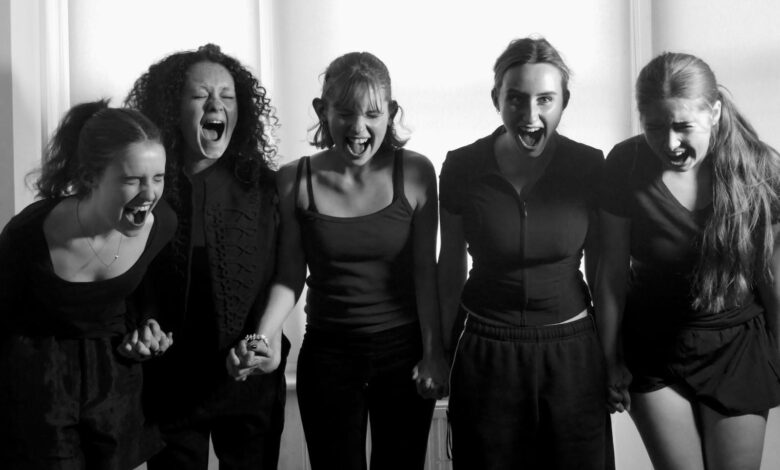
  • Ethan Simm’s VOICE is a play that could only have come from the mind of someone young and ambitious, with deep affection for the stage but equal uncertainty about how to authentically exist on it. Staged with bold simplicity, it speaks to anyone who has ever offered their voice up to an audience.

    Set in a drama school, the play follows a group of students; Jax (Milly Thorpe), Charlie (Lucy Gant), Arlo (Nina Amos), Aoife (Lauren Maguire), and Ariya (Niamh Spillane), as they deliver emotionally raw monologues drawn from their real lives in a class run by their teacher Joan (Annie Porter). The goal: to help them find their voice, primarily by tapping into their own vulnerability. The densely emotional monologues are punctuated by lighter ensemble scenes that capture the chaos of a drama class, and casual conversations between the students, which help to anchor the intense dramatic pieces to the real world.

    VOICE is meta by nature. It’s a play about acting, but more than that, it’s about the awkward, often absurd tension between the stage and the real world. Fourth wall breaks, mid-monologue tangents, and quiet conversations between scenes, blur the line between performer and person and illuminate just how many voices swirl around any piece of theatre.

    The monologues often drift into ellipses rather than land on conclusions, and resist polished story telling. Jax ends her otherwise well-choreographed and punchy piece with a shrug, mumbling that she’s not quite sure how to finish. Ariya, who initially refuses to participate in the exercise, inadvertently delivers a monologue of sorts in the form of a spontaneous rant. Aoife recounts her experience as a Northern Irish woman in England with grace and pain, only to be met with upbeat praise from her peers. Her reaction, “I don’t think yous quite understand the significance of what I just said” gets a laugh from the audience, but it also leaves a lingering sting. Simm highlights the risk involved in turning your real feelings into a product that might not be received in a way you are happy with.

    The staging is minimal: handheld flashlights, with occasional blackouts and spotlights. This stripped-back aesthetic complements the rawness of the piece. The focus falls entirely on the performers and their words, theatre in its most elementary form: voice and body in space.

    The production isn’t without its rough edges. The initial chaos of the drama class is entertaining and captures the high-octane energy of a drama school environment, but the rapid transitions between ensemble exercises, fleeting asides revealing the students’ anxieties, and the start of the monologues can feel a little disorienting. A clearer sense of structure early on would help build anticipation around the daunting challenge of performing these deeply personal pieces. Additionally, while the dramatic monologues are powerful, the characters’ off-stage personalities occasionally feel underdeveloped. With a little more time invested in defining who these students are beyond the drama school classroom, the emotional weight of their monologues could land even more powerfully.

    When glimpses of the students’ off-stage personalities break through, we really understand and warm to them. In one moment, during a birthday song, Jax adds a deliberately rehearsed vocal flourish. It’s an amusing yet telling display of her instinct to embellish any moment that might showcase her talent. Amos is particularly memorable as Arlo, bringing sharp comic timing and a disarming, almost naïve lightness that cuts through the play’s emotional intensity.

    VOICE doesn’t pretend to have all the answers to the many questions it poses, and astutely so. By refusing to tie everything up neatly, Simm creates something authentic to the rich, but still unformed voices the play represents.


    Written by: Ethan Simm
    Directed by: Ethan Simm
    Co Produced by: Lauren Maguire and Elijah Lifton
    Stage Manager: Abby Walsh
    Dramaturg: Sophie Clancy

    Published with Everything Theatre