• Rating: 4 out of 5.

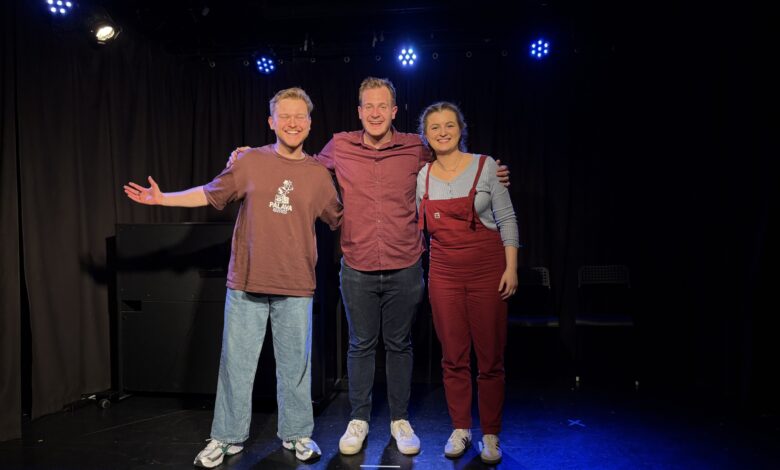
    The League of Improv returns for another monthly show, part of an ongoing series in which a guest stand-up comedian — on this occasion Morgan Rees — effectively emcees the night. Rees chats to audience members, extracting information and jokes, which the improvisers then use as the basis for a series of short improvised sketches. It is a fun night that involves everyone.

    The Phoenix Arts Club provides the perfect casual setting: a long room with tables and sofas stretching all the way back, where people can get up to go to the bar, drift in and out, and where even the bar staff are watching and laughing.

    On this night in particular, everything seemed to fall into place for the League. Rees is excellent in his role: his charm is the glue that holds the night together. He is able to get something amusing even from those who make it very clear they don’t want to be talked to, and this always feels cheeky rather than mean.

    Tonight’s audience also plays a huge part in the success of the evening. The classic crowd-work question “What do you do for a living?” is enough to make a regular stand-up-goer mentally switch off, but here it produces some juicy answers. There’s a man who works in an all-male sex club, a manager on a construction site, and — if you’re collecting evil jobs — someone from Thames Water! Another even announces that he “makes vapes for teenagers”; he doesn’t vape himself.

    Rees even speaks to my plus one. When asked what she does, she explains that she’s a print designer for women’s fashion. When he asks whether we’d know her work, she replies, “well… if you know, you’d know.” Rees amusingly takes offence at the implication that he wouldn’t, and from there the phrase takes on a life of its own. It generates a huge laugh when repeated by one of the improvisers in a sketch about trying to trademark “puma print” — so just black — and becomes an unofficial slogan for the evening, resurfacing when two other audience members repeat it under Rees’s questioning.

    This speaks to how funny the audience members themselves are, and how much they help to propel the night forward. The building-site manager provides a strong callback to an earlier sketch about HR telling a couple they couldn’t kiss at their own wedding, by explaining that he does allow people to kiss at his place of work. This sparks a very funny scene about a man being hopelessly misled by his HR manager about who he is and isn’t allowed to kiss at work.

    Using real audience stories as the foundation for the scenes is a smart choice. It means the show never asks you to suspend your disbelief too much: even when things get wacky, they remain anchored to something real that happened in the room.

    All the improvisers in the group are skilled, some particularly so. The improvised scenes rarely drag, and even when a scene becomes a little lost or confused, the performers embrace and acknowledge the chaos. However, improv is by nature hit and miss, and while some of the strongest material arrives later in the evening, the show does feel a little long at two hours including an interval. They just about pull it off, though, ending on a high with a sketch built around a manager and employee in the audience who are both named David, resulting in a workplace where everyone is called David. It is a neat way to close the evening, allowing for a wealth of callbacks to moments from throughout the show.


    Devised by The League of Improv

    Published with Everything Theatre
  • Rating: 4 out of 5.

    At LAMDA’s Carne Theatre, director Dhruv Ravi takes on  Strategic Love Play, a new play by Miriam Battye. It follows a date between Man or Adam (Emmanuel Olusanya) and Woman or Jenny (Amber Grappy), arranged through an app, that goes… very strangely. The play feels distinctly of the moment: its characters are scarily real, it’s funny, and it’s always buoyed by a tension that reveals the evening for what it really is — a horror show. The stage is set like a pub, in the round, with several tables surrounding the table where the couple is seated. My plus-one and I are given one of them. It’s immersive and very close.

    Adam just wants a normal evening. Jenny is a massive spanner in the works. She manipulates him relentlessly — instigating arguments, dragging him into intense conversations, oscillating between flirtation and tears — until she finally runs off after an emotional crash, exhausted by herself. While the play could be read as two complex characters navigating an awkward date, Jenny is always one step ahead, exploiting Adam’s desire to say and do the right thing. He begins the evening half-committed, jacket still hanging on his shoulder, and by the end is left alone, crying from shock before laughing as realisation hits that the nightmare is over.

    Grappy brings Jenny’s overwhelming dominance to life with total commitment. What initially comes across as overacting soon clarifies into a character who treats life like a poem or a play, desperate to manufacture a “moment.” We learn little about Jenny’s life, yet her behaviour is entirely legible: a fantasist prone to poetic, self-victimising monologues, longing for intimacy without the capacity to sustain it. Her attempts to create a dark, cinematic romance spiral beyond her control, so that in the end she frightens herself, and once her emotional fuel is spent, she shuts off completely.

    Opposite her, Olusanya is the perfect likeable, awkward antidote. His terrified reactions earn early laughs, grounding the play in recognisable discomfort and counterbalancing Jenny’s volatility. We learn far more about his life than we do hers: a girlfriend who left, and a best friend he might have been in a relationship with, had he not sent a disturbing drunken voice note. In many ways, the play is really about him, with Jenny a whirlwind he narrowly avoids being pulled into. He is alone before she arrives, and still there once she is gone; briefly enthralled, then left standing as the vortex passes.

    This is a situation that could only exist in the age of dating apps: a cold open with no shared history, no gradual reading of temperament, no social context to soften the encounter, just two strangers with their own expectations of what a first date will be like.

    Ravi and his team build an impressive rollercoaster from a table, two chairs, and two people. Ghoti Fisher’s fluctuating lighting makes the emotional shifts vividly palpable; by the end, spotlights isolate each table, including the one where Adam is left alone. Veila De Nicola’s subtle sound design, distant noise and understated music bleed into the scene, heightening the intensity and quietly reminding us of the walls around the date and the world continuing just beyond it.

    In this dark dating tale that rings uncomfortably true, audiences will recognise the awkwardness, the anxiety and the craving for stability. When Jenny talks about wanting a “badge” to confirm she’s in a relationship, and Adam eagerly replies, “I want a badge too!”, the room erupts. But the play’s message is clear: a relationship is not a badge, or an anchor, or a stable structure, but is made from people, each with their own problems and circumstances, working within their limits.  


    Directed by Dhruv Ravi
    Movement and intimacy director: Kim Wright
    Produced and costume design by Enza Kim
    Lighting design by Ghoti Fisher
    Sound design by Veila De Nicola

    Published with Everything Theatre
  • Can A Comedian Carry It Alone?

    I set out this year wanting to see live comedy. Comedy of any kind. Along the way I encountered a wide variety of performers: different ages, from different countries, all with different performance backgrounds and levels of experience. However, most of them turned out to be solo, hour-long performances in some capacity. Sometimes that meant straight stand-up, sometimes a narrative one-woman show or maybe a one-man cabaret. And sometimes the category was hard to define at all, beyond being an hour of comedy by a single writer-performer.

    Given how central the hour-long solo show is to the comedy world, it is actually quite a tall order: a single person talking for an hour with the explicit aim of making you laugh. In October, I saw Tom Rosenthal’s stand-up hour Whatever People Say I Am, That’s What I Am, a show largely concerned with longevity as an artist. He jokes about the strain of sustaining comedy over time, and about how unbearable it would be to be around someone who was funny 24/7 – our stomachs aching, our jaws in agony, desperate for relief. It is an absurd exaggeration, but it highlights a real problem with the hour show: it is a long time to laugh consistently.

    Which is why solo comedy shows have to be more than just funny. Alongside the jokes must come other qualities: interest, likeability, sweetness, visual pleasure, emotional texture, even moments of genuine thoughtfulness. A sound structure is vital if a show is not to run out of steam after ten minutes.

    One of the most experienced writer-performers I was lucky enough to review this year was Carl Donnelly, in his tour show Another Round at Leicester Square Theatre. He is clearly well versed in structuring a balanced hour. The opening is tightly packed with jokes, before loosening into something more narrative-driven once the audience is warmed up. It is the pacing of someone who knows when an audience needs momentum and when it is safe to let a story breathe.

    Another strong stand-up hour at Leicester Square Theatre came from Josh Jones with I Haven’t Won the Lottery So Here’s Another Tour Show, though it drew criticism for being slightly insubstantial. That feels harsh, as the hour contained excellent jokes and engaging stories, but it was held back by a lack of organisation. With a clearer structure, the same material could have been shaped into something more cohesive, giving the show that sense of completeness.

    A work-in-progress show from Jin Hao Li was inevitably looser but framed in a much more casual way. He spoke to the audience before the show officially began as well as afterwards, and the hour was held together by his persona, which prompted almost as many “awhs” as laughs. He engaged us with sweetness as well as humour, and that quality felt just as important. To a degree, a show can be held together by charisma alone: Victor Von Plume did not appear to have a fully memorised script, yet the performance cohered through charm and presence.

    Some of the most successful one-person shows I’ve seen this year solved the problem of endurance through sheer richness. Alice Cockayne’s Licensed. Professional. Trained. Qualifiedwas a standout, not because it chased joke density, but because there was always something new happening. Cockayne plays six distinct characters, each with their own story, physicality and costume, and even her outfit changes were folded into the world of the show. Her energy never dipped, and crucially, the show did not rely on the audience to sustain it through laughter alone. We were energised by her, rather than the other way around.

    Story is another anchor for many solo shows, particularly those billed as plays rather than stand-up. Michael Rosen’s double-bill Getting Through It does not describe itself as comedy, yet it drew almost as many laughs as some stand-up sets, despite its heavy themes. The humour emerges organically from a piece that is deeply wise and beautifully told, the laughs feeling like a by-product of attention rather than the goal.

    In other cases, story rescues shows that might otherwise feel slight. Laughing Matters by Alec Watson and Karen by Sarah Cameron West are both anchored by narrative, using plot to give shape and purpose to their humour.

    Then there are shows held together by theme. Sameera Bhalotra Bowers’ What Is Going On? at  Etcetera Theatre takes the premise that academic reasoning is largely useless in real-life situations and spins it into a full-length, highly visual piece, incorporating segments with puppets and PowerPoint.

    There are clear benefits for both emerging and established performers in making a solo hour. In a comedy culture built around touring and festivals, sixty minutes justifies a ticket price, does not rely on other performers, and allows audiences time to properly get to know a comedian. It is also a chance to demonstrate range. The strongest shows I saw this year prove how the hour can become more than a string of jokes or an endurance exercise. Comedians can choose who they want to be onstage, and what drives their style – whether that is energy, tight narrative control, or casual charm. I am looking forward to seeing what this structure offers next in 2026: how new comedians reinvent the hour, and how established ones continue to squeeze more out of it.


    Published with Everything Theatre

  • Rating: 4 out of 5.

    Even in comedies, jokes are often treated as decoration rather than substance – meant to entertain while pointing to deeper themes. But the RSC’s new production of Twelfth Night, directed by Prasanna Puwanarajah, doesn’t shy away from a focus on fun. Devoting more time to clowning and the comedic subplot – in which Olivia’s uncle Sir Toby Belch and Sir Andrew Aguecheek trick the uptight Malvolio into believing Olivia loves him – Puwanarajah creates a unique production that draws attention to different types of fools, how they operate, and highlights the tragedy that exists as an equal and opposite force to comedy.

    Michael Grady-Hall’s Feste is the likeable, highly trained clown: ridiculous in a polished way, funny through skill and control rather than earnest clumsiness. He sings, juggles, and commands a crowd, performing choreographed routines that are genuinely beautiful. A rope dropped from the ceiling is pulled to black out the stage; in the interval, he throws balls into the audience; and at the end of ‘The Rain It Raineth Every Day’, when he blows out the spotlight, we see the delicate side of the professional fool.

    Edward Gorey-inspired design by James Cotterill gives the clowning heightened intricacy. The minimal greyscale lighting opens up the stage, revealing the back curtain, which emphasises the fragility of his body within the huge  Barbican Theatre. In mid-air, Grady-Hall skilfully walks the tightrope between safety and disaster.

    Samuel West’s incredibly funny Malvolio is the real fool however, and the character who makes us laugh most. His foolishness is raw and untrained, with clumsy physicality and famous yellow stockings. Feste’s ruffled yellow-and-black outfit, complete with banana codpiece, almost looks good compared to Malvolio’s disastrous ensemble. When he appears above the stage, gazing down at Olivia (Freema Agyeman) with wildly misplaced confidence, the audience begins to laugh hard. West’s nasal voice is a perfect comic instrument: his off-beat command of his sounds shines when he studies the forged letter and insists he sees Olivia’s handwriting, her “c’s, her u’s, and her t’s!”.

    Music plays a massive part in how we are pulled through the production. An original score by Matt Maltese oscillates between melancholy, soulful tunes and vaudeville-like playful numbers. A vast organ made of oversized pipes looms centrestage, around which the characters whirl like clockwork figures inside a music box, executing slapstick ensemble scenes with orchestral precision.

    Joplin Sibtain as Sir Toby Belch and Demetri Goritsas as Sir Andrew Aguecheek form the dynamic duo at the centre of the carousel of foolish side characters. They generate plenty of laughter, but their dominance within the group deepens the audience’s sympathy for Malvolio. Puwanarajah claims that Twelfth Night contains some of Shakespeare’s funniest and saddest moments and here there’s an equally tragic payoff to Malvolio’s hilarious fate: when he is socially ostracised, the moment lands with force, and we feel almost complicit for laughing along.

    By focusing strongly on clowning and comedy, the production slightly downplays romantic threads, particularly between Orsino (Daniel Monks) and Viola as Cesario (Gwyneth Keyworth). This shifts emphasis away from jokes where the punchline is subversion of gender roles, which could feel less titillating in our contemporary society where the idea of the feminine encroaching on the masculine is less exhilarating.

    Weighting Twelfth Night as Puwanarajah does is a daring move, one that risks making the production appear somewhat superficial. The significance of plot and subplots are almost reversed, yet this choice reveals just how rich the comedic subplot is when given focus. It is not only an entertaining and visually impactful spectacle, but also a worthwhile investigation into where and how fun arises within one of Shakespeare’s most comically charged plays.


    Directed by Prasanna Puwanarajah
    Set and Costume Design by James Cotterill
    Lighting design by Zoe Spurr and Bethany Gupwell
    Composed by Matt Maltese
    Sound Design by George Dennis
    Produced by Holly Reiss

    Published with Everything Theatre
  • Rating: 2 out of 5.

    So many comedy plays rely on oddness as their engine, but this kind of humour is far harder to execute than it appears. Surreal jokes need to feel genuinely strange — surprising, even dark and a bit disturbing. When the oddness isn’t odd enough, or the darkness not quite dark enough, or the ideas not substantial enough, the result risks feeling less like well-crafted absurdist comedy and more like adults playing.

    One Woman and Her Bitch is designed to be chaotic, provocative, and purposefully weird. Yet it often lands somewhere between a bit much and not quite enough.

    Written by William Lyons — a philosopher and academic specialising in the “theatre of the mind” — the play mixes classical Greek comedy, panto, modern political and cultural commentary, and nods to Beckett and Brecht. It is set in a version of London where painted landmarks sit alongside hand-drawn columns of ancient Greece, creating a liminal world that blurs the classical and the contemporary. This hybrid setting is one of the production’s most successful elements, subtly linking the mundanity of the present with the richness of mythic history and dissolving the hierarchy between them. Even the characters’ names reinforce this connection: Diogeneia (Katrin Mellinger), shortened to “Dodgey,” and her dog Cerberus (Emma Wilkes) level the streets of London with classical myth.

    The central issue with the play is that its comic engine never really ignites. Much of the humour rests on the dynamic between the human–dog double act, and while there is a Beckettian symbiosis to their relationship, the affection they’re meant to share never fully reaches the audience. This is partly because the characterisations drift into discomfort: Cerberus’s animalistic behaviours — licking, biting, twitching are a bit unnerving, and Diogeneia’s occasional growling only heightens the awkwardness. The cast also don’t quite have the timing needed to lift the subtler jokes.

    Even the attempts at harsher or more provocative comedy tend to misfire. Whenever other characters call Cerberus a dog, she insists on being called a “bitch,” a running gag that seems designed to revel in crudity but never feels especially daring or transgressive — just a bit uncomfortable. The costumes are visually quite challenging: latex yellow pants layered over tartan tights and the peculiar dog outfit create an aesthetic that feels confrontational within the confines of a small venue.

    The disconnect between cast and audience especially scuppers the show’s panto ambitions. Attempts at participation — including a plea for suggestions of different types of working dogs — fizzle out so that the performers end up answering their own questions. The interactive element isn’t established early enough for spectators to feel invited into the game, and by the time participation is requested, the cumulative effect of so many jokes failing to land has left the room too hesitant to respond.

    A handful of songs punctuate the show, including ‘Give A Bitch A Bone’ and a closing lullaby lamenting humanity’s destruction of the world. These musical moments gesture toward deeper thematic intentions, yet they never quite develop into anything substantial. The production also brushes against the criminalisation of homelessness — most notably in Dodgey’s eventual arrest for vagrancy — but these instances remain fleeting, offering allusion rather than insight.

    Despite an admirable effort, particularly given a last-minute cast change, the show’s intentional strangeness too often veers into incoherence, overshadowing both comic payoff and philosophical ambition. For a production built on big ideas and bold absurdity, One Woman and Her Bitch ultimately becomes a bizarre blur of half-formed concepts.


    Written by William Lyons
    Directed by Victor Sobchak

    Published with Everything Theatre

  • Rating: 3 out of 5.

    PRESSURE 3 brings together emerging theatre makers who are split into four teams, given the same theme, budget, and rehearsal time, and tasked with creating a half-hour play performed over three nights. Audiences vote each night, and a winner is announced at the end. The theme is “time is running out,” producing four pieces: Forwards or BackwardsCookie DoughSad Face, and A Big Tip.

    The format is great fun. The competitive structure and tight constraints add energy, and seeing several plays born from the same prompt creates a strong conceptual hook. Ironically, it takes the pressure off any one piece needing to be perfect; the night becomes an exploration of how stories form—how quickly they take shape and what they need to land.

    Forwards or Backwards centres on an injection that reverses ageing—a decision everyone must make at 40. Joric (Cameron Krough-Stone), a university lecturer approaching the deadline, debates whether to take it. Although there’s a central relationship between Joric and his much younger partner Lirae (Madeline Price), the play unfolds largely through monologues about what ageing means and the hypothetical consequences of reversing it: would a brain tumour return at 32 if you de-age? What happens to couples when only one person takes the injection? It plays more as an intellectual exercise than a drama. Rooted in speculative ideas rather than human conflict, the concept is hard to fully realise in a short play.

    I can’t help noting that from here the plays become increasingly sexual. It’s funny that, under tight creative constraints, so many pieces gravitate toward sexual relationships—you wouldn’t be crazy to assume it’s an unspoken requirement.

    Cookie Dough, the second play, is far more successful at building an engaging world quickly. It follows two co-workers—Bernie (Abby McCann) and Polly (Grace Hudson)—meeting just before Bernie leaves for Glasgow to pursue her dream of starting a food truck. Polly rushes in, drenched and nervous, instantly getting laughs. The subtext is particularly well done: you can feel the world beyond the half-hour, the shared history between the two women. It feels like we’re watching the juicy end of a much longer story, yet still left wondering what might happen next.

    Sad Face, centred on a couple—Jonnie (Arthur Campbell) and Katie (Giorgia Laird)—whose night is disrupted by their friend Archie (Harrison Sharpe). It’s Katie’s first relationship, and she wants it to feel special; they sleep together, but Jonnie has already emotionally checked out and plans to move home and move on. The play doesn’t open with quite the same clarity or personality as Cookie Dough, but once the central betrayal lands, the situation is instantly recognisable, prompting equal parts laughter and outrage at Jonnie. It’s the piece with the clearest moral culprit, using a personal relationship to explore a wider ethical dilemma.

    A Big Tip packs a surprising number of twists into its half hour. Geordie (Will Lockey), still closeted, visits a male escort, Oscar (Jack Donoghue), for his first sexual experience with a man. Too nervous to proceed, he ends up talking instead, revealing that both his stepfather and stepbrother are also gay. Just as he finally feels ready, Oscar admits he’s actually straight, leaving Geordie mildly betrayed. In the end, Geordie asks only for a hug, and they kiss. Despite Oscar’s lack of attraction, the moment feels honest, marking a small but meaningful step in Geordie’s self-acceptance. It’s perhaps the night’s most cohesive piece, a short life-altering interaction with a stranger.

    I can’t call the winner, but I’m curious which play comes out on top. What strikes me is how differently each team positions its story within a broader narrative timeline. Cookie Dough feels like an episode in a longer series; A Big Tip like a self-contained short story; Forwards or Backwards like the opening of a dystopian novel; and Sad Face like the final, bitter moment of a failing relationship. Each group interprets the theme in its own way – from speculative to moral to deeply interpersonal – giving every piece something distinct. It’s a fun night, whether you’re interested in the mechanics of theatre, or simply enjoy watching well-made, emotionally charged stories.


    Written by: Kyle Eaton, Andy Sellers, Catriona Stirling, Oliver Woolf
    Directed by: Apostolos Zografos, Saniya Saraf, Aaron Finnegan, Jessica Whiley
    Produced by: Gregor Roach, Arthur Campbell

    Published with Everything Theatre

  • Rating: 4 out of 5.

    Josh Jones returns with a new show, I Haven’t Won The Lottery So Here’s Another Tour Showthat plays like a round-the-houses tour of his life, told through a series of joke-embellished stories about his family, dyslexia, Dancing On Ice, his relationship, his hometown and “bumming,” among other things.

    The opening is clever: a bit about reading hate comments—not his own, which he says he doesn’t really look at, but those of a comedian he personally can’t stand. It’s a subtle acknowledgement that everyone in the room will have their own opinions about the show, while quietly reassuring us he doesn’t plan to take any of them too seriously, and that he enjoys judging as much as we do. It perfectly matches the slightly unbothered and mischievous attitude that runs through the rest of the hour.

    Once the show gets going, the structure is loose—sometimes too loose—and the transitions between stories can feel abrupt. There are genuinely brilliant sections, but they’re interspersed with weaker moments where the energy dips. Jones mainly cycles through three recurring strands: his Manchester upbringing in what he affectionately calls “a scummy family,” his now-comfortable life with his doctor boyfriend, and the odd opportunities that come with being a successful comedian, including a brief stint on Dancing On Ice, where he twisted his ankle in week one but still got a full cheque. These threads are fun individually, but they could be woven into a clearer overall narrative. Doing so would help sustain the show’s momentum and make the hour feel tighter and more satisfying.

    There’s even a brief detour into the slave trade, which feels as crazy to describe here as it did when he introduced it onstage. The material is fine, but it only highlights that his strongest work lives in the stories about the people around him. Those scenes are vivid, rowdy, and warm; you can practically see the sitcom version already.

    His bit about his mum going to the local travel agent to book a holiday, but instead buying the woman’s dog—meaning she then can’t go on the holiday because she has to look after it—is exactly the kind of chaotic domestic comedy he excels at. Likewise, his grandad insisting he won’t die until he sees Jones marry his boyfriend, followed by Jones imagining the family accusing him of “killing grandad with your gay love!” Jones’s writing is genuinely sharp, full of subtle jokes tucked into the wording—like the idea of “killing” someone with “love”—that elevate the comedy without the audience having to do any extra headwork.

    Another standout is his story about desperately wanting a McKenzie coat, only for everyone around him to tell him it was a “gay coat.” The coat takes on a life of its own, transforming from a coat that looks gay into a coat that makes you gay. Much of Jones’s humour comes from that instinctive, ridiculous shouting-match energy of childhood—life throws something absurd at you, so you throw something equally absurd back.

    Jones tells us that he doesn’t want to create anything too serious or high-concept—he just wants to tell jokes, but he has some seriously good writing and a clear talent for crafting little comic worlds that could easily be linked together. As of now, he knows how to put on a fun night.


    Written by: Josh Jones

    Published with The Reviews Hub

  • Rating: 4 out of 5.

    With his cap on and two earrings firmly in place, Carl Donnelly takes to the stage with Another Round, his latest hour of laid-back, anecdotal comedy. Last year, he tempted fate with a show about feeling good about going into middle age — and life promptly reminded him of its brutality. This time, he unpacks the fallout with his signature casual charm.

    The first section of the show is a flurry of fast-paced, crowd-pleasing material on generational divides, ageing, Instagram vanity, and caveman diets, amongst other things. Its original material delivered in a familiar stylex, and the laughs come thick and fast. Once the audience is nicely warmed up, Donnelly slows the pace and takes us through some longer stories. He shares tales from his travels in India, searching for somewhere to drink, infiltrating a speakeasy in a local man’s house, and managing to bond with the initially suspicious locals over shared admiration for international sports stars — not to mention the joys of his alcoholic advent calendar. In some ways, it’s every man’s dream. 

    The second half takes a more personal turn, delving into his recent illness — a bout of internal bleeding exacerbated by an evening of taming a raucous cruise ship crowd by downing a queue of pints. Even this grim material is handled with wit and charisma, culminating in a surprisingly funny and heartfelt reflection on his daughter’s brush with bacterial meningitis. He admits that he thought about trying to take these subjects on to produce a heavier, more introspective show about processing this trauma, but fears this could lead to disaster if done wrong. He prefers to treat these subjects as he would any other, showing how lightness and humour can be a remedy for anything, from the frustration of having to endure influencers on Instagram to near death experiences.

    The opening section draws in new audience members with broad, accessible observations, but by the end it’s the scatological and the deeply personal that have his core fans roaring. He paints wild, hilarious scenarios, and you believe every word. His go-with-the-flow nature explains how he gets into so much trouble; he’s the sort of man who could probably squeeze in a quick gig after taking his pre-op laxative — if it kicks in on time, that is. No dodgy decision goes unrewarded with a hilarious dose of disaster. 

    Many stand-up shows hinge on one central theme or concept, but Another Round doesn’t seem to need one. Patterns emerge naturally through Donnelly’s stories, and combined with his relaxed confidence on stage, it feels as though you’ve known him all your life by the end. The title captures the spirit of the evening perfectly: Donnelly’s long-time fans feel like old friends, and newcomers are quickly made to feel part of the gang. It’s as if everyone’s gathered for a few pints and a catch-up, and you leave with the sense that another round, and another hour of stories, isn’t far away.


    Written by Carl Donnelly

    Published with Everything Theatre

  • Rating: 3 out of 5.

    Karen is a new one-woman show by Sarah Cameron-West that follows in the tradition of Phoebe Waller-Bridge and Miranda Hart: a protagonist, written and performed by Cameron-West herself, conjures an entire world as she attempts to navigate troubled relationships and the social demands of office life. The unnamed protagonist has broken up with by her boyfriend, Joe, at Alton Towers on her 30th birthday, halfway through eating a Calippo. To make matters worse, he leaves her for another woman, Karen — a colleague who also works with the ex-couple.

    Cameron-West’s performance style is distinctive: she never directly addresses the audience, instead speaking to invisible characters who are realised through her monologues. She does a commendable job bringing these characters to life, and despite frequent shifts in perspective, the plot never becomes confusing. Moments when she interacts with audience members by pretending they are other characters are particularly enjoyable. The writing is clever in this regard, allowing the audience to visualise every character clearly. The production also makes excellent use of lighting to heighten the comedy. A red wash, for instance, represents her raging mind when she speaks to Karen, in contrast to what she actually says in normal lighting.

    It is clearly a well-crafted script, and there are jokes throughout, but the piece suffers from a few problems in its central characterisation. Cameron-West’s performance is energetic and expressive, but it remains fixed on a single emotional note: anger. She erupts into furious outbursts almost immediately and rarely steps away from them, leaving little space for the audience to see the woman behind all the shouting and crying. While the show embraces female rage and challenges the idea that women should express their anger in a palatable way, it does so in a manner that feels one-dimensional and ultimately exhausting. She touches on themes such as jealousy, disappointment, and feelings of inadequacy, but never explores them deeply enough to draw meaningful conclusions, leaving the story feeling somewhat thin.

    One of the few reflective moments comes when she considers how her parents’ successful relationship has affected her, suggesting both that she should be able to find love because she knows what it looks like, and that her father has set an impossible standard for the men in her life. Yet this reflection feels misplaced in a story about losing someone she loved rather than struggling to find connection. This all matters because it prevents her from becoming a sympathetic character, which is vital if the audience is to be on her side through her misfortune.

    The ending, in which the protagonist explodes during a meeting with her boss, yet is rewarded with a transfer to the company’s New York office, feels more obscure than optimistic. She faces no real consequences for her erratic behaviour in the meeting and we don’t get the satisfaction of seeing her work through her emotions and come out the other side. A new beginning appears to fall into her lap rather than being something she earns.

    The scaffolding is in place for Karen to be a great show: the relationships, staging, and humour are all there, but the situations and themes would benefit from deeper exploration, and the piece as a whole from greater emotional variation. There is the potential for Karen to offer real catharsis to anyone who has felt wronged and compelled to suppress their emotions, but for that to resonate, the audience needs to feel a stronger connection to the protagonist.


    Written by Sarah Cameron-West
    Directed by Evie Ayres-Townshend
    Produced by Sarah Cameron-West
    Lighting by Oliver McNally
    Sound by Sarah Spencer

    Published with The Reviews Hub

  • Rating: 3.5 out of 5.

    Jeremy Nedd’s From Rock to Rock is a meditative and atmospheric piece that interrogates the theft of Black cultural expression through the story of the court case brought by rapper 2 Milly against the video game company behind Fortnite for appropriating his dance move, the Milly Rock. It serves as a poetic resistance against the commodification of Black creativity by corporate forces, which extract without offering credit, compensation, or context.

    The performance opens in near silence, with five dancers—Brandy Butler, Nasheeka Nedsreal, Zen Jefferson, Jeremy Guyton, and Nedd himself—entwined to form a single solid mass, echoing a rock at the front of the stage. Their slow, careful shifting evokes the passage of geologic time: the rock erodes, splits, and reforms. These bodies become tectonic and sculptural, shaped by nature’s invisible forces. When the stone finally fractures into five distinct forms, thunderous claps snap the calm. Suddenly, the Milly Rock appears.

    This move drives the structure of the show. Dancers break into duos, groups, and formations that fracture and reassemble like shifting plates. One performer glides across the stage on a hoverboard wearing an astronaut helmet, like a robotic ghost; another stomps with granite-block shoes. These surreal figures conjure a world suspended between the physical and the virtual.

    In one standout moment, a joyous sequence breaks through the automation. The dancers smile as if they’re enjoying every movement, and we see humanity return to their bodies. Later, Butler’s soulful solo by the rock is a moment of musical and emotional gravity. Her voice is astonishing, rising like heat from cold stone. The finale is a poetic monologue delivered by Jefferson as Butler plays the piano, his message ringing clear: “I gotta be me, but that doesn’t mean I’m gonna be me for free.”

    The Milly Rock is deceptively simple—arm swipes and rhythmic footwork—but danced in perfect synchrony, the performers resemble avatars, programmed to replicate identical movements on a loop. At one moment, the soundtrack cuts, and the dancers move in silence as though they were never responding to music, but instead to code. Their technical skill is undeniable, but this exactitude introduces a kind of hypnotic monotony. The work unfolds at a tectonic pace: slow and cerebral rather than action-packed or plot-driven. To fully engage, the viewer must surrender to its rhythm.

    The ambience is elevated by carefully curated visual and audio elements. The set evokes an icy mountain landscape, while ethereal soundscapes mimic howling wind and crunching stone. The dancers wear soft tracksuits and move almost silently across the stage, leaping and stepping as though they are weightless, more pixel than person. The lighting—sometimes brighter-than-white, other times awash in soft yellows against a nighttime blue—echoes the contrast between nature and simulation, body and data.

    From Rock to Rock is not always an easy watch, but it is a thoughtful and skilfully executed piece that invites the audience to engage mindfully with the issues it quietly meditates upon.


    Choreographed by Jeremy Nedd

    Published with The Reviews Hub